

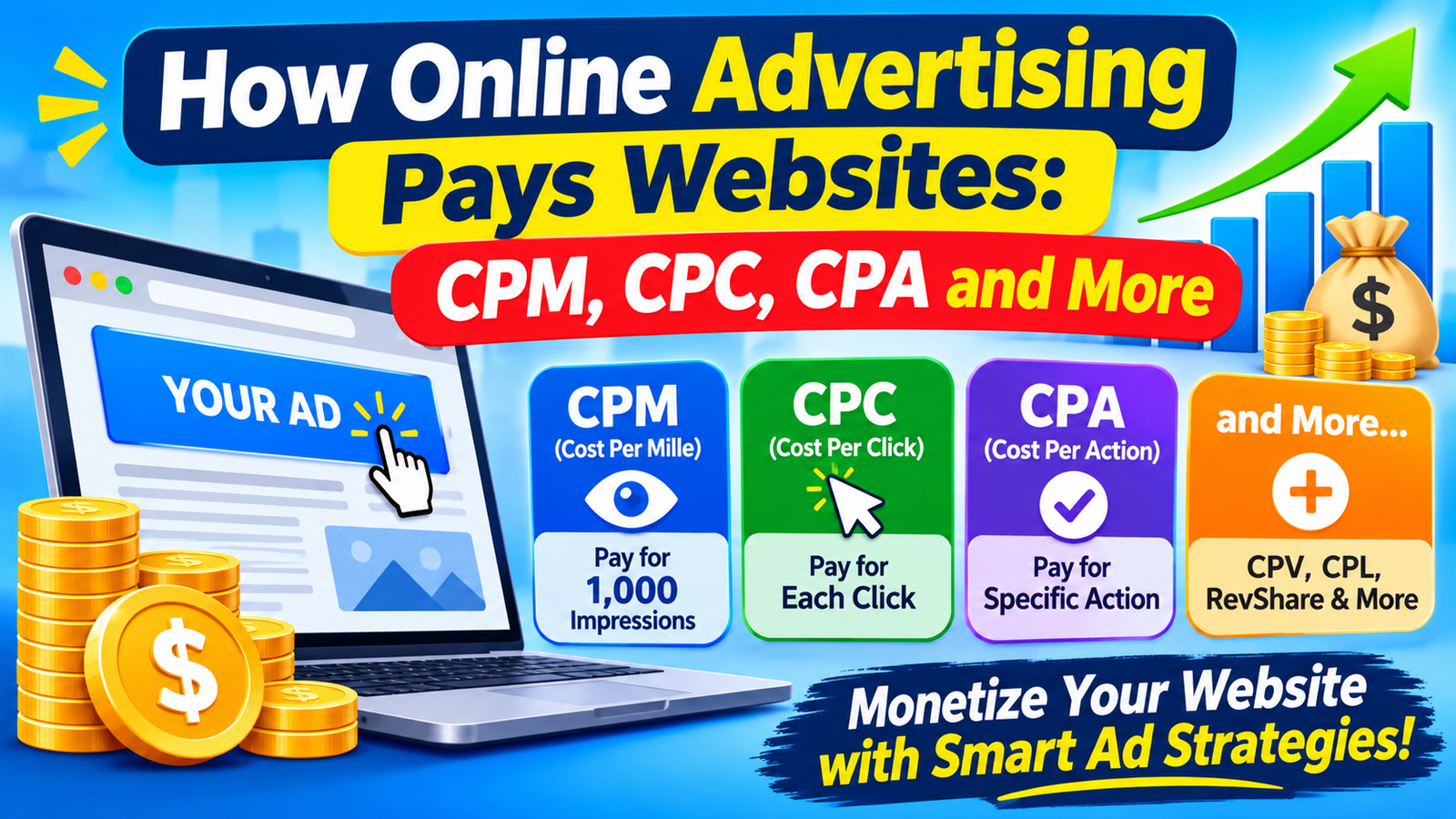
How Online Advertising Pays Websites: CPM, CPC, CPA and More
Most of the free services on the internet are paid for by advertising. This includes news sites, apps, video platforms and reward websites. To understand how a website earns, and why it has rules about how users behave, it helps to know the basic pricing models in online advertising.
The three main players
- Advertisers want to promote a product or service and pay to reach an audience.
- Publishers own websites or apps where advertisements are shown.
- Ad networks and exchanges connect the two sides, handle the technology and take a share of the revenue.
Common pricing models
CPM: cost per thousand impressions
The advertiser pays a fixed price for every 1,000 times an advertisement is displayed. The letter M comes from the Roman numeral for one thousand. CPM is typical for brand awareness campaigns, where the goal is simply to be seen.
CPC: cost per click
The advertiser pays only when someone clicks. This model is common in search advertising. Because payment depends on a user action, networks work hard to detect fake and accidental clicks.
CPA or CPL: cost per action or lead
The advertiser pays when a visitor completes a specific action, such as registering for an account, installing an app or filling in a form. This is the model behind many offer and survey walls. Payouts are higher than for impressions or clicks, but only a small percentage of visitors complete the action.
CPV: cost per view
Used mainly for video, where the advertiser pays when a viewer watches a video for a minimum amount of time.
What affects how much a publisher earns?
- Audience location: advertisers usually pay more for visitors from countries with higher consumer spending, which is why campaigns are often targeted by country.
- Device and browser: some campaigns target only mobile or only desktop users.
- Traffic quality: real visitors who engage with the content are worth more than bots or low-quality traffic.
- Content and audience fit: a finance audience attracts different advertisers than a gaming audience.
- Ad placement and format: clear, well-placed ads usually perform better than cluttered pages.
Why fraud prevention matters
Advertisers lose money if impressions or clicks come from bots, scripts or people who were pushed to click. For this reason ad networks run automated systems that look for unusual patterns, and they may reject traffic or close accounts that appear fraudulent. Honest behavior from users and publishers protects the whole system.
What this means for users of reward platforms
Rewards are paid from advertising and partner revenue. If a platform sets rules about one account per person, no automated tools or restricted use of VPNs, the reason is usually to keep traffic valid so that advertisers continue to pay. Following the rules protects your earnings and your account.
Key takeaway
Advertising pays for much of the free internet. The price depends on impressions, clicks or actions, and the quality of traffic matters a lot. Understanding this makes the rules of reward websites easier to understand.

We publish beginner-friendly guides about cryptocurrency, wallet security and safe online earning. Articles are for education only and are not financial advice. Spotted a mistake? Let us know.